E-Commerce
Why Selling Only on Etsy & Amazon Is Costing Bhadohi Rug Artisans Their Margins
Jul 11, 2026 • 10 min read
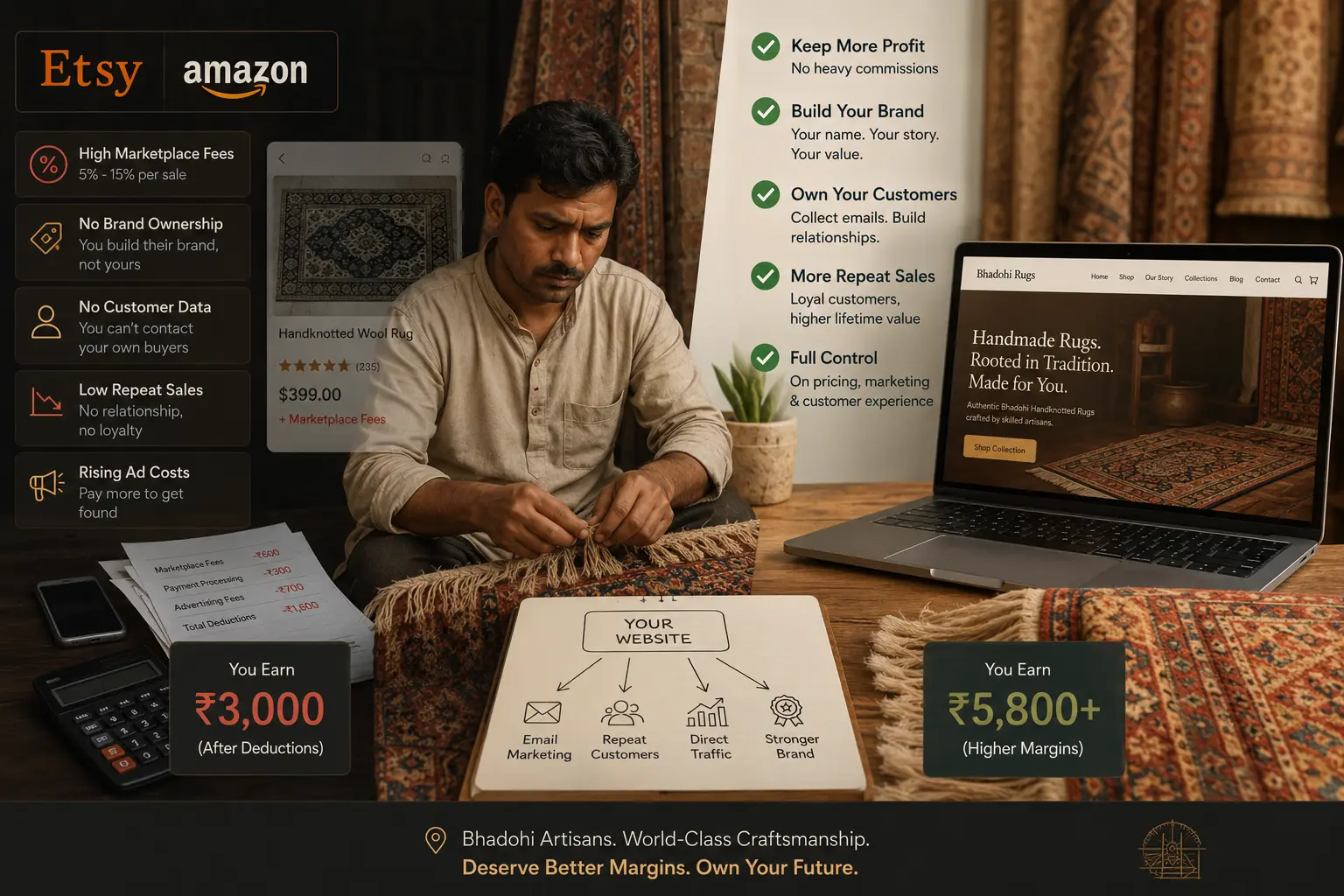
For generations, the artisans of Bhadohi, Jaipur, Mirzapur, Panipat, Kashmir, and other renowned weaving regions of India have created handcrafted rugs admired across the world. Their craftsmanship has found customers in the United States, Europe, Australia, and the Middle East through global marketplaces such as Etsy, Amazon, Wayfair, and other B2B and B2C platforms.
These marketplaces have undoubtedly opened doors that were once difficult to access. They provide instant visibility, built-in traffic, payment processing, and access to international buyers.
However, many artisans and exporters eventually discover a difficult reality:
Building your entire business on someone else's marketplace also means building your future on someone else's rules.
As businesses grow, the limitations become more apparent. Profit margins shrink, customer relationships disappear after each sale, competition intensifies, and one unexpected policy issue can temporarily—or sometimes permanently—interrupt years of hard work.
This article explores why relying exclusively on marketplaces can hold back long-term growth and how having your own website creates a stronger, more sustainable business.
Marketplaces Are Excellent for Starting—But Risky for Depending On
Selling on Etsy or Amazon is similar to opening a small shop inside a large shopping mall.
Thousands of visitors walk past your store every day. You don't need to build the mall, maintain its security, or attract visitors yourself.
That convenience has enormous value, especially for businesses entering online commerce for the first time.
The challenge begins when all of your sales come from that single mall.
If the mall changes its policies, increases rent, closes your shop, or simply moves another seller ahead of you, your business immediately feels the impact.
This is exactly how marketplace dependency works.
The Hidden Cost of Marketplace Fees
Every sale on a marketplace comes with costs that aren't always obvious at first.
Besides the listed commission, sellers often pay for:
- Marketplace selling fees
- Payment processing charges
- Advertising costs
- Currency conversion fees
- International transaction charges
- Shipping-related deductions
- Promotional discounts
Individually, these costs seem manageable.
Combined, they can significantly reduce the profit earned on every handmade rug.
Imagine spending weeks weaving a premium handcrafted carpet, only to see a substantial portion of the final sale value deducted before the payment reaches your account.
For businesses operating with handcrafted products, where labour, wool quality, natural dyes, and finishing already require significant investment, protecting margins becomes increasingly important.
You're Building Their Brand—Not Yours
Consider this question.
When a customer buys a rug from Amazon, what do they usually remember?
Most buyers remember buying from Amazon.
When someone purchases through Etsy, they often remember buying from Etsy.
Very few customers remember the individual artisan behind the product unless they've already developed a relationship with that brand.
This creates a long-term challenge.
You may create exceptional products, receive excellent reviews, and consistently deliver quality—but much of the trust remains attached to the marketplace rather than your own business.
As a result, every future customer often has to discover you all over again.
Your Customers Don't Really Become Your Customers
One of the biggest limitations of marketplaces is customer ownership.
When someone purchases directly from your own website, you can gradually build a lasting relationship through newsletters, product launches, care guides, loyalty programs, and personalized recommendations.
On many marketplaces, however, access to customer information is intentionally limited.
You complete the sale, ship the order, and the relationship largely ends there.
The next time that buyer wants another rug, there's no guarantee they'll return to your store. Instead, they may purchase from whichever seller appears first in the search results.
Over time, this makes customer acquisition significantly more expensive because every sale often requires finding a completely new buyer.
One Policy Issue Can Interrupt Your Entire Business
Marketplace policies exist for good reasons. They help maintain quality, prevent fraud, and protect buyers.
However, even experienced sellers occasionally face situations where listings are removed, products are temporarily hidden, or accounts are suspended while reviews take place.
Sometimes these actions result from genuine mistakes.
Sometimes they happen because automated systems detect unusual activity that later proves to be harmless.
Regardless of the reason, the impact can be significant.
If nearly all of your business depends on one marketplace account, even a temporary suspension can interrupt orders, reduce cash flow, and delay customer communication.
This doesn't mean marketplaces are unreliable.
It simply highlights the importance of not relying on a single platform for your entire business.
Diversifying your online presence helps reduce that risk.
Standing Out Is Becoming More Difficult Every Year
The global handmade rug market has become increasingly competitive.
Every year, thousands of new sellers join online marketplaces.
Many offer similar designs, similar pricing, and similar photography.
When buyers search for “handmade wool rug,” they may see hundreds—or even thousands—of competing listings.
Your handcrafted masterpiece appears beside factory-made alternatives, imported products, machine-made rugs, and aggressive discount offers.
Instead of competing on craftsmanship alone, sellers often find themselves competing on price.
That race rarely benefits artisans.
Price Shouldn't Be Your Only Competitive Advantage
Handmade rugs are not ordinary products.
Every knot represents hours of skilled craftsmanship.
Each design carries cultural heritage passed down through generations.
Natural materials, traditional weaving techniques, and artisan expertise create value that cannot be measured by price alone.
Yet marketplaces often encourage buyers to compare products primarily through:
- Lowest price
- Highest ratings
- Fastest delivery
- Sponsored placement
Very little space exists to tell your story.
Without that story, buyers may struggle to understand why one handcrafted rug deserves a premium over another.
Your Website Gives Your Craftsmanship a Home
A dedicated website changes the conversation.
Instead of competing inside a crowded marketplace, you create your own digital showroom.
Visitors don't just see products.
They discover your journey.
They learn about your weaving process.
They understand your materials.
They meet the artisans behind the craftsmanship.
They explore collections that reflect your design philosophy rather than marketplace categories.
This transforms a transaction into a brand experience.
Tell the Story Behind Every Rug
Modern customers, especially international buyers, increasingly value authenticity.
Many want to know:
- Where was this rug woven?
- Who made it?
- What materials were used?
- Is it hand-knotted or hand-tufted?
- How long did it take to create?
- What makes this design unique?
A marketplace listing provides only limited room for storytelling.
Your own website gives you unlimited space to explain the heritage, craftsmanship, and traditions behind every collection.
Stories create emotional connections.
Emotional connections create loyal customers.
Own Your Brand Instead of Renting Visibility
Every improvement you make to your own website benefits your business directly.
When someone searches Google for your company name, they discover your brand—not another marketplace.
When a customer bookmarks your website, they return to your catalog.
When journalists, designers, architects, or interior decorators recommend your products, they can link directly to your business instead of a third-party marketplace listing.
Over time, your website becomes a long-term business asset that continues growing alongside your reputation.
Better Margins Mean Greater Business Stability
Selling through your own website doesn't automatically eliminate every cost.
You'll still invest in marketing, payment processing, logistics, photography, and customer support.
However, many of those investments strengthen your own business rather than someone else's platform.
Instead of continuously paying for visibility inside a marketplace, you're building an online presence that belongs entirely to you.
Over time, stronger margins provide more flexibility to:
- Invest in better materials
- Hire additional artisans
- Expand internationally
- Improve packaging
- Launch new collections
- Strengthen customer support
Healthy businesses are built on sustainable margins—not just higher sales volume.
A Website Opens New Opportunities Beyond Direct Sales
A professional website serves many purposes beyond e-commerce.
It becomes a platform for:
- Interior designers looking for custom projects.
- Hospitality businesses sourcing rugs for hotels and resorts.
- Architects searching for bespoke collections.
- International wholesalers seeking manufacturing partners.
- Export buyers looking for long-term suppliers.
- Retail stores interested in private-label production.
Many of these buyers prefer working directly with manufacturers rather than discovering them through crowded marketplaces.
Your website helps establish that credibility.
The Strongest Businesses Combine Both Strategies
The question isn't whether you should leave Etsy or Amazon.
For most artisans, the answer is no.
Marketplaces remain valuable channels for reaching new customers and expanding internationally.
The smarter approach is to avoid making them your only channel.
Successful brands often use marketplaces to generate initial exposure while simultaneously investing in their own digital presence.
Their website becomes the foundation of the business, while marketplaces serve as additional sales channels rather than the entire business itself.
This balanced approach reduces risk, strengthens branding, and creates greater control over future growth.
Final Thoughts
The artisans of Bhadohi, Jaipur, Mirzapur, Panipat, Kashmir, and other weaving regions have built a global reputation through generations of remarkable craftsmanship.
That craftsmanship deserves more than competing solely inside crowded marketplaces.
Platforms like Etsy and Amazon can introduce your products to the world, but they cannot fully represent your story, your heritage, or your brand.
Your own website allows you to build direct customer relationships, strengthen brand recognition, improve long-term profitability, and create a business that isn't entirely dependent on the policies or algorithms of any single marketplace.
The future of handmade rug businesses isn't about choosing between marketplaces and a website.
It's about using marketplaces as one sales channel while building a brand that customers can recognize, trust, and return to for years to come.
Frequently Asked Questions
Should rug sellers stop selling on Etsy or Amazon?
No. These marketplaces remain valuable for reaching international buyers. The goal is to reduce dependency by also building your own website and customer base.
Why is owning a website important for artisans?
A website gives artisans complete control over their brand, product presentation, customer relationships, and long-term marketing strategy.
Can a website help increase profit margins?
Yes. While operating a website has its own costs, it can reduce reliance on marketplace commissions and create opportunities for repeat customers, direct inquiries, and wholesale partnerships.
Which rug businesses benefit most from having their own website?
Handmade rug manufacturers, exporters, wholesalers, custom rug makers, luxury carpet brands, home décor businesses, and artisan collectives can all benefit from establishing an independent online presence.
Selling Bhadohi rugs on marketplaces but ready to own your brand and margins? Veda Foundry builds e-commerce sites with catalog management, direct checkout, and WhatsApp integration — so you're never one policy change away from losing your business.
Start a conversation on WhatsApp