 VF / 003
The tool that used to be enough
Most serious businesses do not start with a custom platform. They start with whatever ships: a WordPress site, a Shopify store, Google Sheets, a WhatsApp group, a form plugin, a hiring board, a booking SaaS. That is correct. Off-the-shelf software is how you learn the workflow before you encode it.
The mistake is staying there out of loyalty after the tool has become the bottleneck. Staff export CSVs every Friday. Vendors mail product data because the admin cannot handle their catalogue. Students cannot find a result page that should be one search. Founders become the integration layer. The website looks fine. The operation does not.
You need a custom platform when the software starts deciding what the business is allowed to do.
What “custom web platform” actually means
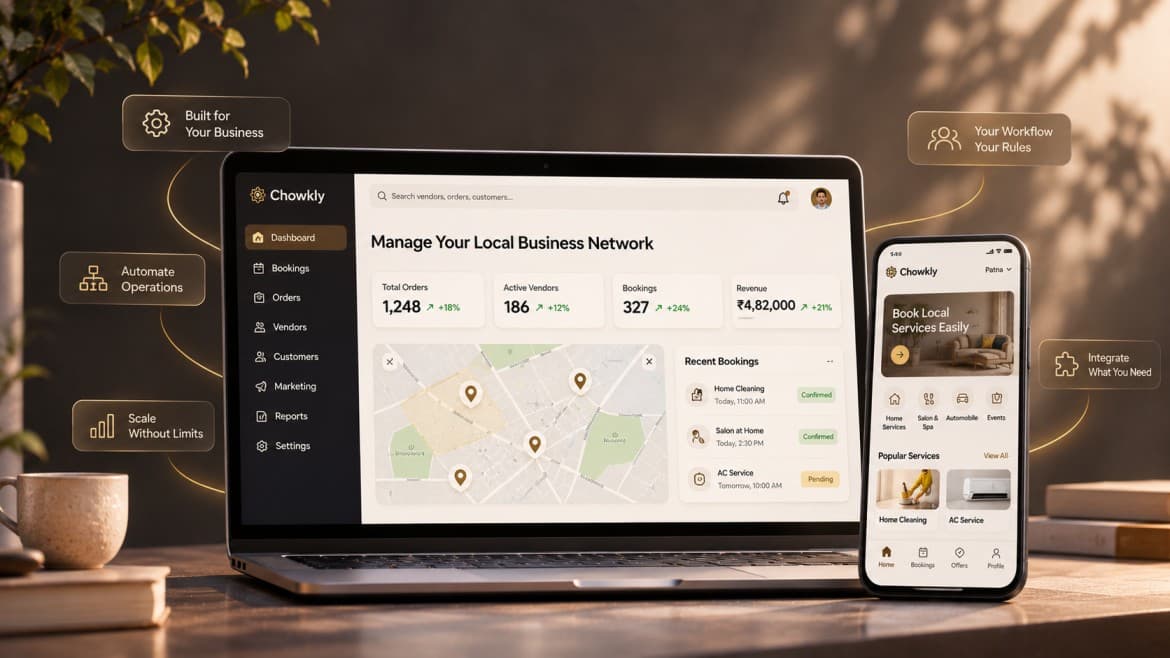
It does not mean a unique programming language or a refusal to use existing services. It means the product is modelled around your users and jobs: roles, permissions, inventories, applications, commissions, content types, and the screens people live in every day. A theme is a costume. A platform is an operating system for one company.
- Marketplaces: more than one seller, more than one buyer, rules in the middle.
- Portals: vendors, partners, students, or staff logging into a workspace that is not a blog.
- Products: a web application with its own objects — jobs, listings, bookings, cases — not “pages and posts.”
- Integrations: payments, SMS, search, ERPs, or app stores treated as part of the design, not as afterthought plugins.
Navikara is a useful picture: jobs, results, admit cards, scholarships, and alerts in one hub. That is not a brochure with a form. Antique Bharat and Rugs Bhadohi sit closer to commerce. The question is always the same: does the software match the work, or is the work being stuffed into a shape it does not fit?
Signals you have outgrown the off-the-shelf tool
You do not need a custom platform because a designer is bored of the theme. You need one when the daily workarounds have a cost you can name.
- 01Shadow systems
The real process lives in spreadsheets, email, or WhatsApp because the official tool cannot hold it.
- 02Role collisions
Vendors, staff, and customers need different views. You are faking that with admin accounts and hope.
- 03Plugin debt
Each new need adds another extension. They fight each other. Updates feel dangerous. Nobody owns the whole.
- 04Unshippable features
A buying flow, search, or dashboard you can describe in a sentence but cannot build without fighting the platform.
- 05Scale that hurts
Traffic or catalogue growth makes the site slow, fragile, or expensive in ways a theme setting will not fix.
Name the shape before you name the stack
“Custom website” is too vague to price or design. The useful first cut is the shape of the product. A marketplace has supply, demand, and trust in between. A portal is a workplace for a known group. A content-heavy site with a few tools is still a website. A product is software people return to.
- If the hard problem is selling goods, start from commerce and customise the journey — do not reinvent carts for sport.
- If the hard problem is many actors (vendors, applicants, agents), you are in platform territory.
- If the hard problem is search, alerts, and dense records, you are building an information product, not a homepage.
- If the hard problem is still “we need to look credible,” you need a sharper website, not a custom architecture.
Getting this wrong is how companies pay for a platform and receive a slow brochure, or pay for a theme and try to bolt on a marketplace. The stack comes after the jobs.
Build, stitch, or buy
Custom does not mean everything is written from zero. The grown-up choice is three-way. Buy the commodity: auth providers, payments, email, hosting. Stitch what already works: a headless CMS, a commerce API, a search service. Build the part that is actually yours: the workflow, the roles, the screens staff cannot live without.
Teams get hurt at the extremes. Building a payment gateway is waste. Buying a rigid SaaS and then hiring people to copy data out of it every night is also waste. The platform should be thinnest where the world already solved the problem, and thickest where your business is specific.
Custom the workflow. Buy the plumbing.
Architecture should make the next year cheaper
The point of a custom platform is not a launch demo. It is the third feature you add without starting over. That means clear ownership of data, boring reliability, and an admin your team will actually use. A beautiful buyer front with a hostile back office is not finished software. It is a trap for the founder.
- Model the real objects first: listings, applications, orders, vendors — not “pages.”
- Give each role only the screens they need. Power-user clutter is how people go back to Excel.
- Plan search, permissions, and audit trails early if more than one company or campus will use it.
- Write down what you will not build in version one. Platforms die from appetite, not from missing a gradient.
The cost of waiting is usually operational
Founders delay custom work because a rebuild looks like a luxury. The bill is already landing elsewhere: slower fulfilment, missed applications, vendors who will not onboard, ads that send traffic into a search box that cannot find last week’s result. Those costs rarely show up as a line item called “wrong software.”
Waiting is right when the process is still changing every fortnight. Waiting is expensive when the process is stable and the tool is the thing that keeps inventing exceptions. A short discovery — goals, users, the Friday workaround — is cheaper than another year of plugins.
A decision checklist
Use this before you request a custom quote or sign another SaaS annual plan.
- Write the three jobs the software must do next quarter. If a current tool already does them without a workaround, stay.
- List every spreadsheet, WhatsApp group, and manual export that exists because the official system cannot.
- Name the roles: who logs in, what they must not see, what they do every day.
- Circle the one flow you still cannot ship after a year of trying. That is the custom core.
- Decide what you will buy (payments, email, hosting) so the build stays about your workflow.
- If you cannot describe the workflow on a whiteboard, do discovery first. Do not start with a stack argument.
A custom web platform is not a personality upgrade for the website. It is what you build when the business has a shape, and the current tools refuse to hold it. That is the signal.
Questions
- When should a business move from Shopify or WordPress to a custom platform?
- When the tool starts shaping the business instead of serving it: workarounds in spreadsheets, staff re-entering data, features you cannot ship, or a buying flow the theme cannot express. Custom is justified by operations and unique workflow, not by boredom with a theme.
- What is a custom web platform?
- Software built around your workflow — marketplaces, portals, dashboards, role-based access, and integrations — rather than a page builder with plugins. It still uses proven building blocks. The difference is that the product matches how your buyers, vendors, or staff actually work.
- Is a custom platform more expensive than SaaS?
- Upfront, usually yes. Over time, the cost of workarounds, failed plugins, and lost operations can be higher. The honest comparison is not theme price versus build price. It is what it costs to keep bending the business around software that will not bend.
- What are signs we are not ready for a custom build?
- If the process is still unclear, the catalogue is tiny, or an off-the-shelf tool already does 90% of the job with no painful workaround, stay put. Custom software needs a real workflow to encode. Discovery should come before architecture.